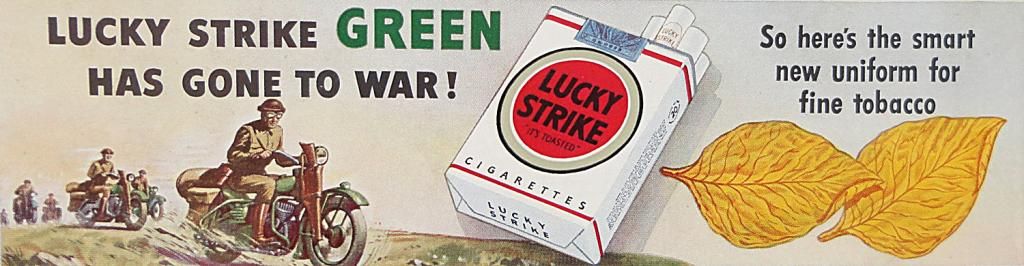
If you're wondering what that ad campaign is about, Lucky Strike packs used to be green all over, but market research done in the early forties showed that the green pack colour wasn't popular with women, so they changed the pack to white with just a green Lucky Strike logo, which also saved on printing costs too. However, they thought that changing the logo colour from green might further improve popularity with women, but they needed a good reason to say why they were going to change the colour. Fortunately for American Tobacco, the company which makes Lucky Strike, the answer came in the form of WW2...
Many US men had gone off to fight in WW2, and were often reliant on their wives and sweethearts sending them cigarettes. So the company had particularly good reason for wanting US women to favour the Lucky Strike brand. George Washington Hill, the president of American Tobacco, had been told in early 1942 that there was only about three month's supply of green ink left in the US, because the ink used metal in its base, which was by then a strategic material. This was only partially true, because the only really importantly strategic metal used in any ink on the Lucky Strike pack artwork, was in the gold coloured ring around the green logo, and it would have been easy to drop that without changing the logo's green colour. So, American Tobacco stopped making tobacco tins, making cardboard ones instead, dropped the gold trim from the Lucky Strike logo, and changed the main logo colour from green to red, then came up with the campaign 'Lucky Strike has gone to war!', promoting the reason for all the changes they made as being to help the war effort. They frequently announced in radio shows which they sponsored, that they were saving enough copper and tin to produce 400 light tanks annually, which was probably untrue, but nobody really cared very much about checking the veracity of any advertising during the war if it appeared patriotic.
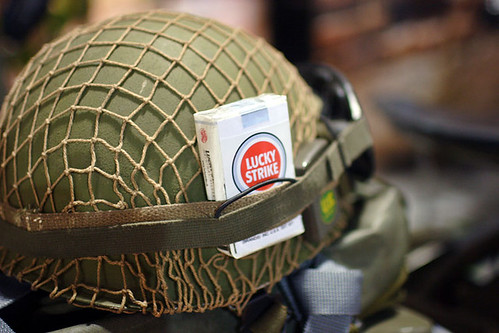
That is why you nearly always see US soldiers in WW2, Korea and Vietnam etc, with a pack of Luckies, because even today it is still thought of by many in the US as a 'patriotic' brand, which in fairness to them, it probably is.